Texas map redraw sparks national fight
A mid-decade redistricting effort by Texas prompted retaliatory map changes in other states, leading to legal debates and voter confusion.
By Larissa Shah ·
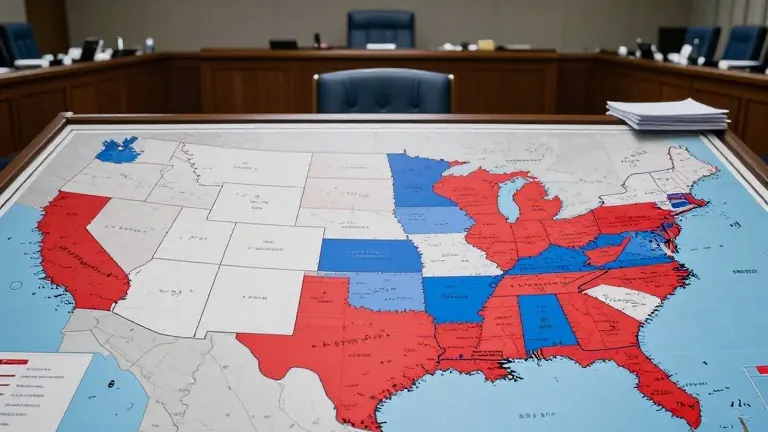
Texas congressional districts often look like abstract art, with shapes resembling butterflies or cartoon characters. However, the current geometry reflects a high-stakes political battle that began in the summer of 2025. President Donald Trump asked state leaders to redraw the map to add up to five seats for Republicans.
The move was unusual because states typically only redraw maps once every ten years after a census. Abbott, the Texas governor, ordered lawmakers back to Austin to implement the change. The new map was designed to flip five previously Democratic seats to Republican control before the 2026 midterms.
Democratic legislators attempted to block the vote by leaving the state. They reduced their numbers below the 100-member quorum required for the 150-member House to do business. After a few weeks of absence, they returned, and the new map passed into law.
The Texas action triggered a cascade of reactions across the country. Matthew Wilson, a political science professor at SMU, described the situation as a partisan tit for tat. California and other states responded to Texas, creating a back-and-forth cycle of map changes between Democratic and Republican controlled states.
Mapmakers generally use two main tactics to influence elections. Cracking involves splitting a group of voters across multiple districts to dilute their power. Packing involves concentrating a specific group into as few districts as possible, giving them overwhelming majorities in those areas but leaving them with little influence elsewhere.
The Supreme Court ruled in 2019 that excessive partisan gerrymandering is not unconstitutional. Federal courts do not have the authority to strike down maps based on political advantage alone. Wilson noted that while political parties are not a protected class, mapmakers cannot use race or ethnicity as the primary basis for disenfranchisement.
Most Americans disapprove of the practice. A recent YouGov poll found that 71 percent of respondents believe states should not draw districts that intentionally favor one party. Wilson suggests that while voters know something is happening, it remains a lower priority for those not deeply engaged in politics.
The effectiveness of these partisan maneuvers remains uncertain. Wilson warned that voters might prefer more competitive districts where outcomes are less predictable. If current efforts fail to deliver expected results, the result is known as a dummymander.