Lunar Water Reserves Limit Sustainable Moon Cities to 10,000 People
Harvard and Durham researchers calculate that known water deposits support only small settlements for centuries, challenging tech leaders' visions of massive lunar metropolises.
By Amina Kaminski ·
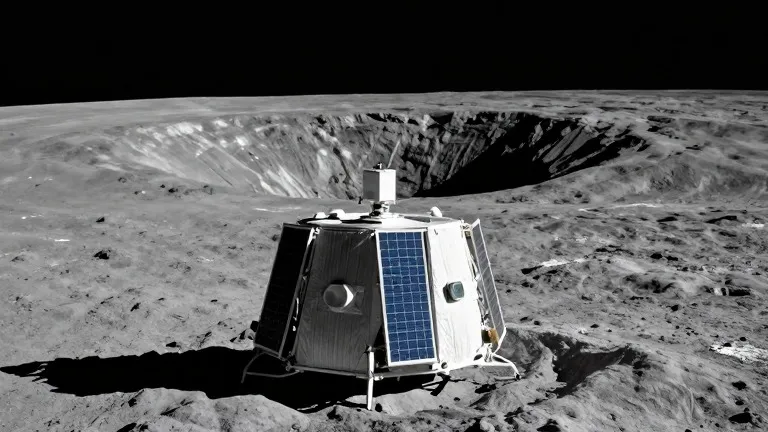
SpaceX CEO Elon Musk and Blue Origin CEO Jeff Bezos have promised large human populations in space within decades, but new data suggests the moon's water supply cannot support that scale. A study published in Frontiers in Space Technologies indicates that lunar water reserves are sufficient for a town of 10,000 people for centuries, but only for a million people for about 100 years.
Martin Elvis, a senior astrophysicist at Harvard University's Smithsonian Astrophysical Observatory, and Jonathan McDowell, an honorary professor at Durham University, analyzed power and water requirements for lunar habitation. They found that solar and nuclear power could sustain one million residents, but water availability is the limiting factor. The researchers assumed a total water reserve of one billion tonnes, consistent with current estimates for permanently shadowed polar regions.
Elvis compared the estimated water volume to an aquarium the size of Central Park filled until the Statue of Liberty was just underwater. He described the reserve as a small lake that could not supply a big city for long. The calculation assumes 98 percent of water is recycled, matching the rate achieved on the International Space Station. Without that high efficiency, the timeline for a million-person city would shorten further.
Elvis noted that the one billion tonne figure is likely generous. He estimated the amount of recoverable water is probably one percent of the initial estimate, which would reduce the sustainability timeline for a million residents from 100 years to one year. Gordon Osinski, a professor of planetary geology at Western University, said satellite measurements have uncertainties. He believes the water exists but may resemble Arctic permafrost, with sub-millimetre ice crystals mixed into soil that are difficult to extract.
McDowell stated that the findings should not discourage future missions. He argued that the truth is never negative and that attempting projects that are not going to work is the real problem. The study provides a concrete baseline for planners who aim to build permanent infrastructure on the lunar surface. The discrepancy between executive visions and physical constraints highlights the need for precise on-ground confirmation of water availability.