Crows solve visual motion tasks in 0.5 seconds, outpacing primate benchmarks
University of Tübingen researchers found carrion crows use identical decision logic to monkeys but process the data at double the speed.
By Larissa Shah ·
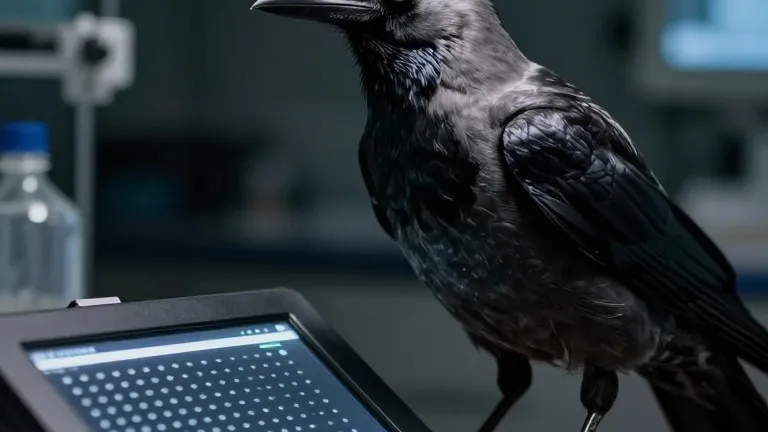
Andreas Nieder and Philipp Schmidbauer at the University of Tübingen have demonstrated that carrion crows perform complex visual calculations with the same precision as primates, but at twice the speed. The study, published today, challenges long-held assumptions about how different brain architectures handle ambiguous information.
The team tested two hand-raised carrion crows using a random-dot-motion task. The birds sat before a touch-sensitive monitor displaying white dots on a black background. They pecked a target to indicate the direction in which the dots were drifting. A correct response earned the bird a mealworm. This setup mirrored experiments previously conducted with monkeys, where eye movements signaled the choice.
Nieder explained that the primary goal was to replicate the conditions exactly. "We intentionally wanted to have exactly the same random-dot motion task," he said. The only procedural change involved the method of response, as crows pecked while monkeys used eye movements. This strict adherence to protocol allowed for a direct comparison of the underlying neural processes.
The researchers varied the difficulty of the task by adjusting the percentage of dots moving coherently. At the easiest level, 81 percent of the dots moved together, making the direction obvious. At the hardest level, only 3 percent moved in a unified direction, making the signal barely distinguishable from random noise. The team also included a condition where zero percent of the dots moved, offering no correct answer.
In primates, the neocortex accumulates visual evidence over time until a specific threshold is reached, triggering a decision. Birds lack a neocortex, which left a gap in scientific understanding regarding their decision-making capabilities. Nieder noted, "This was the big question. How [would] a differently organized avian brain encode decisions?" The data showed that the crows used the same mathematical logic as the primates to resolve the ambiguity.
The key difference was the speed. The crows reached their decisions in half the time required by the monkeys. This finding indicates that a brain without a neocortex can arrive at decisions through a comparable process, just faster. The results suggest that the specific architecture of the brain does not dictate the speed of the decision-making algorithm, provided the necessary sensory input is available.