Mars Cloud Formation Requires Humidity 100,000 Times Stronger Than Earth's
New simulations show a daily Martian cloud forms through a rare ice process that demands extreme atmospheric conditions never directly observed before.
By Amina Kaminski ·
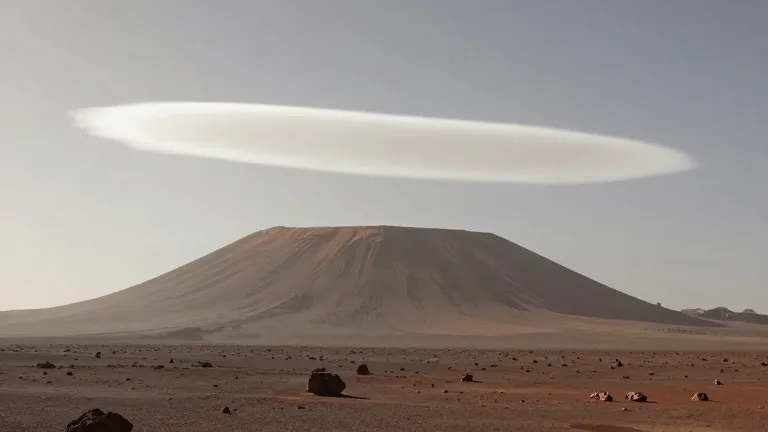
Humidity levels more than 100,000 times greater than any measured on Earth are required to form a specific cloud on Mars, according to a new study published in Nature Geoscience. This extreme threshold is central to explaining how a narrow cloud, known as the Arsia Mons Elongated Cloud, appears and disappears daily near the planet's largest volcano.
The cloud stretches over 1,000 miles, a distance comparable to the straight line between New York and Kansas City. It grows longer during Martian spring and summer mornings before dissipating. A probe first detected the feature in 2018, but researchers struggled to explain its formation for years because standard cloud physics did not apply.
Jorge Hernández-Bernal, a planetary scientist at Sorbonne Université in Paris, led the modeling effort. He stated that the simulations only succeeded after adding what he termed "exotic physics." This specific physical process appears in textbooks but is typically treated as theoretical and assumed not to occur in nature. "Once we included this physics in our simulations, the AMEC emerged just as we hoped," Hernández-Bernal said in a press release.
The study proposes the cloud forms through homogeneous nucleation, where water vapor turns directly into ice crystals without dust or salt particles to seed the process. On Earth, clouds usually form when vapor condenses onto tiny debris. Hernández-Bernal described the Martian process as "wholly unexpected," comparing it to condensation forming in the middle of a room rather than on a window surface.
The Arsia Mons volcano, which stands 65,000 feet tall, plays a critical role in creating the necessary conditions. When wind hits the volcano, it generates a powerful wave that lifts moist air high into the atmosphere within minutes. This rapid ascent causes the temperature to drop by 30 degrees Celsius in just 10 minutes, a sharp change that enables the ice crystals to form.
Scientists had long theorized that similar nucleation processes might occur in the upper atmospheres of Earth and Venus, but no direct observation had confirmed it. The extreme humidity required for the process likely explains why it had not been seen on Earth. Researchers did not previously know that such high humidity levels existed on Mars, a gap in knowledge that highlights how much less is understood about the Martian atmosphere compared to Earth's. Hernández-Bernal called the successful reproduction of the cloud "remarkable."