The 4 Million Daily Lunches That Define Spain Are Changing
A new book argues that the traditional set-price lunch is struggling against rising costs and shifting habits, but it is far from extinct.
By Anastasia Volkova ·
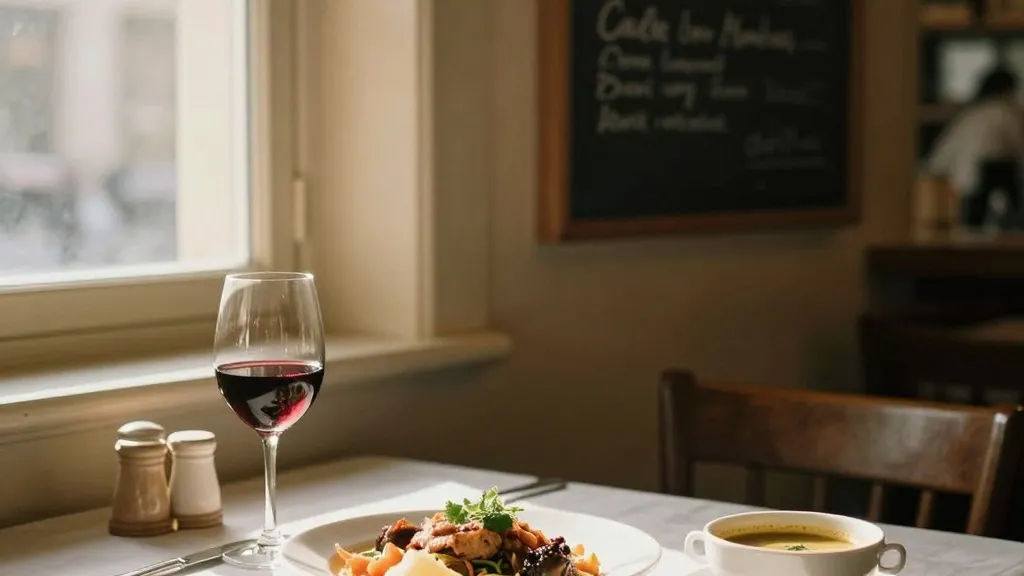
Roughly four million Spaniards still sit down to a fixed-price lunch every weekday, a tradition that has anchored the country’s midday routine for over half a century. However, this daily ritual is quietly losing ground to faster eating habits and higher operating costs. The menú del día, a standard offering of a starter, a hearty main, and a dessert or coffee, is facing its most significant test in decades as the nation’s food culture evolves.
The format was not always a beloved national staple. It originated in the mid-1960s as a strategic tool for tourism. Manuel Fraga, the information and tourism minister during Francisco Franco’s regime, designed it to show foreign visitors that Spain had recovered from the post-war scarcity. The menu was intended to prove that food was plentiful, affordable, and of high quality to a skeptical international audience.
Regulations at the time were strict. Restaurants had to serve a soup starter and a main course of egg, fish, or meat, chosen from a list of at least three options. The accompanying drink had to be a quarter-litre of pure Spanish red or white wine with a minimum alcohol content of 12 percent. Prices were capped between 50 and 250 pesetas to ensure accessibility. By the early 1970s, the name was changed to move it away from its tourist origins and encourage local workers to enjoy the meal themselves.
Today, many people are unaware of this bureaucratic history. Lakshmi Aguirre, a Spanish food journalist who recently published a book on the subject, noted that many people were surprised to learn about Fraga’s role. She observed that Spaniards often forget these historical details, yet the tradition has become so embedded in daily life that its decline feels like a loss of community.
The economic pressures are significant. The average price of the daily menu has risen to 14.70 euros. For small, family-run restaurants, rising energy and food costs make it difficult to maintain a rotating selection of dishes. Some owners have simplified their offerings to a single dish of the day. Others have adapted by incorporating Latin American foods to reflect the changing demographics of their neighborhoods.
Aguirre argues that these changes are natural, as the menu has always mirrored the society that eats it. She suggests that the tradition is in trouble but not finished. Her own criteria for a good lunch spot include simple, non-frozen dishes and a menu that changes frequently. She looks for signs of regulars and a chalkboard that avoids trendy ingredients like avocado or truffle, preferring the familiar comfort of a vegetable stew or hake in green sauce.
The decline is also driven by time. Many workers who are short on lunch breaks now opt for quick solutions, such as bringing food from home or microwaving ready meals. This shift away from a sit-down meal is eroding the social function of the restaurant. Aguirre emphasizes that the menu is more than just a cheap meal. It serves as a meeting point where families with limited budgets can eat out and individuals living alone can find a sense of company.
The core value of the tradition lies in the time it affords. Aguirre notes that the privilege is not just about affordability, but about having the space to enjoy the food without rushing. As the habit fades, what is being lost is this shared, unhurried moment that has defined the Spanish workday for generations.
Source: The Guardian